Easy Parkour: Escape Run Obby
- 4.3
- Rating
- 5.00M
- Installs
- Free
- Price

 Analysis by App-foxy
Easy Parkour: Escape Run Obby is the kind of casual game I open when I want a quick test of timing rather than a long story, complicated strategy, or serious commitment. Developed by Blox Global, it puts the focus on parkour-style obstacle challenges and straightforward movement. The appeal is immediate: guide a character through a course, react to what is ahead, and try to improve after a mistake.
That simplicity is both its strongest quality and its main limitation. I found the concept easy to understand within moments, which makes it approachable for younger players and anyone looking for a light game during a short break. At the same time, players expecting a deep progression system, extensive customization, or a large competitive community may find the experience narrower than a more ambitious platformer.
The game is free to download and is suitable for Everyone, so it is positioned as an accessible choice for a broad audience. It has an average rating of 4.3 from around 7.8 thousand ratings, with more than 5 million installs. Those figures suggest that the basic formula has reached a substantial audience, although popularity alone does not guarantee that its particular style of obstacle play will suit every player.
You May Also Like

 Google Keep - Notes and lists
Google Keep’s Quiet Growth Shows the Appeal of Simpler Notes
As mobile work gets busier, Google Keep keeps winning a simple contest: capture a thought quickly, find it later, and get on with the day.

 Blood Strike: 2.5 Anniversary
Blood Strike’s Loadouts Turn Every Drop Into a Tactical Gamble
A close look at Blood Strike’s custom loadouts: how fast access to signature weapons reshapes its battle royale rhythm, rewards preparation, and narrows the gap between fights.

 Pandora - Music & Podcasts
Pandora’s Music Is Easy to Start, but Harder to Recover
Pandora’s strength is its low-effort path from a seed to a station. Its weak spot is how much confidence it asks you to place in connection, setup, and quiet recovery.

 8 Ball Pool
 Is Built on Rivalries, Rematches, and Routine
A close look at the rivalries, rematches, shared routines, and unanswered safety questions that turn a quick pool match into a persistent mobile community.

 Samsung Music
’s Quiet Strength Is Playing What You Already Own
Its reach comes less from spectacle than from dependable access to a personal library. That simplicity is both the app’s strongest retention engine and its ceiling.

 AccuWeather: Weather Radar
AccuWeather Review: A Quick, Clear Forecast for Everyday Decisions
For everyday plans, the best forecast is the one you can understand quickly. AccuWeather makes rain timing, radar, and local conditions easy to act on, with a few trade-offs.
More From Our News Desk



How the parkour challenge feels in everyday play
The first thing I noticed is how quickly the game communicates its purpose. There is no need to learn a complicated rule set before starting. The courses are built around movement, timing, and avoiding mistakes, so the learning curve comes from playing rather than reading instructions. That makes it a natural fit for a short session while waiting for a bus, taking a break between tasks, or handing a phone to someone who wants to try something immediately.
The controls are described as smooth, and that is an important part of the experience here. In an obstacle game, even a small delay or awkward input can make a failure feel unfair. When movement responds consistently, I can usually tell whether I missed a jump because of my timing or because I misunderstood the route. That distinction matters: a game built around repeated attempts needs the player to feel that improvement is possible.
I would not approach this as a traditional platform adventure with a strong narrative. Its pleasure comes from the immediate challenge of getting through the course. The best sessions are the ones where I stop rushing, watch the spacing between obstacles, and make small adjustments instead of treating every section as a race. That change in attitude is one of the more useful lessons the game encourages, even without turning itself into a formal training experience.
Small-session appeal and the cost of a mistake
A realistic use case is a player who has only a few minutes and wants something more active than scrolling through a feed. Easy Parkour: Escape Run Obby works well in that situation because the objective is obvious and the action begins quickly. I can play a short attempt, put the phone down, and return later without needing to remember a complicated plot or a long list of missions.
The trade-off is that repeated failure can become tiring if I am not in the mood for precision. Casual does not necessarily mean effortless. Obstacle games often ask for concentration in short bursts, and this one is best enjoyed when I accept that progress may come through repetition. Someone looking for a relaxing game with almost no pressure may prefer a puzzle app, idle game, or simple matching title instead.
One practical tip is to treat each attempt as a way to learn the rhythm of a section rather than as a final test. I found that rushing after a mistake usually created another mistake. Slowing down at unfamiliar obstacles makes the controls easier to judge and helps separate a genuine difficulty spike from a moment of impatience. That approach is especially useful for younger players, who may otherwise interpret a failed run as evidence that the game is impossible.
Progress, repetition, and the feeling of pressure
The central question for long-term enjoyment is how much satisfaction a player gets from repeating obstacle courses and refining movement. If the pleasure comes from shaving away errors and reaching a difficult section more reliably, the game can remain appealing beyond the first few attempts. If the player needs a story, character development, or a constantly changing set of activities, the basic parkour loop may feel limited sooner.
I also think the emotional pressure of this genre deserves attention. A course can look simple while still demanding careful timing. That creates a particular kind of tension: the player understands what should happen but has to execute it cleanly. For some people, that is exactly what makes a casual game engaging. For others, a missed jump near the end is more frustrating than fun.
Parents choosing a game for a child should consider that distinction. The Everyone age rating makes the title broadly suitable from a content perspective, but suitability also depends on temperament. A child who enjoys retrying a challenge may find the game motivating. A child who becomes upset by repeated failure may need limits on session length or a different type of casual game with less performance pressure.
Another useful habit is to stop after a few unsuccessful attempts if concentration has clearly dropped. Parkour games reward attention, and continuing while frustrated can make the controls seem worse than they are. Taking a break is not just general advice; it is particularly relevant here because the core activity depends on repeated, precise reactions rather than passive progress.
Free access and the spending question
The game is free to play, but it includes in-app purchases ranging from $0.99 to $169.99 per item. That is the most important financial detail for anyone deciding whether to install it. The presence of purchases does not by itself show that spending is required, nor does it establish how strongly the game encourages purchases during play. I would therefore approach the title as a free download with optional spending available, not as a completely purchase-free experience.
For my own use, the sensible approach would be to begin without buying anything and judge whether the basic obstacle challenges are enjoyable on their own. That gives a clearer answer than purchasing early to solve frustration. If the game is fun only when a paid item removes an obstacle or shortens repetition, its value becomes less attractive for players who want a straightforward casual experience.
The wide purchase range also means families should pay attention to device-level purchase controls. This is especially important when a child uses a shared phone or tablet. I would not hand over unrestricted access simply because the game has an Everyone rating. Content suitability and spending protection are separate issues, and responsible setup matters more when the title offers items at very different price points.
At the same time, I would avoid assuming that every player will face aggressive monetization or that every purchase affects competitive ability. Those conclusions cannot be drawn from the purchase range alone. The fair way to assess the game is to separate what is known from what remains a personal test: the download costs nothing, optional items are available, and the value of those items depends on how the individual player experiences the game.
Fairness when skill is the main attraction
Parkour games are most satisfying when success feels connected to timing and control. That is why fairness is more important here than it might be in a purely decorative casual app. If a player can understand why a run failed and adjust accordingly, the challenge feels meaningful. If progress seems to depend on unclear rules or spending, the central appeal weakens.
From a player’s perspective, I would test fairness in a simple way: play several attempts without purchasing anything and observe whether the core route remains understandable and controllable. I would pay attention to whether mistakes are consistent, whether the character responds predictably, and whether improvement comes from learning rather than from waiting or paying. This is a more useful test than judging the game by its visual simplicity.
I would also keep competitive expectations modest. The available description presents Easy Parkour: Escape Run Obby as a casual parkour challenge, not as a verified esports-style contest or a formal leaderboard experience. That means I would play it for personal improvement and completion satisfaction rather than assume that every result is part of a carefully balanced competitive system.
This distinction helps identify who should skip it. Players seeking ranked competition, detailed match statistics, or a clearly documented skill-based multiplayer environment may be happier with a dedicated competitive platformer. Easy Parkour: Escape Run Obby is a better fit for someone who wants accessible obstacle play and is comfortable measuring progress against their own previous attempts.
What I would check before committing to long-term play
There are a few practical unknowns I would resolve through ordinary use rather than guess about. The first is how much variety the courses provide over time. A short session can be enjoyable even with a compact selection, but long-term value depends on whether the challenges continue to feel fresh or become familiar too quickly.
The second is the role of purchases in progression. The listed purchase range confirms that optional items exist, but it does not explain whether they are cosmetic, convenience-focused, or connected to access and advancement. I would watch the game’s prompts and play normally before deciding whether any item offers meaningful value. A free game is only a good deal if the unpaid portion remains enjoyable for the player.
The third is how the game handles the player’s sense of momentum. In this genre, a smooth control system can make a compact course feel rewarding, while awkward pauses or unclear transitions can make even a well-designed obstacle feel irritating. I would give the game enough attempts to learn its rhythm, but I would not force myself to continue if the same friction appears repeatedly.
These are not reasons to dismiss the title. They are the questions that matter most when a game’s public description is intentionally brief. The store summary emphasizes smooth controls and parkour challenges, which accurately communicates the basic idea, but a player still needs to decide whether the available challenge, replay value, and purchase structure match personal expectations.
Device compatibility and practical expectations
The current version is 1.14, and the game supports devices running Android 6.0 or later. That makes it relevant to people who keep an older Android phone rather than upgrading frequently. Still, compatibility on paper does not tell me how comfortable a particular device will feel during fast movement. Screen size, touch responsiveness, and general device condition can all affect a game where timing matters.
If the controls feel inconsistent, I would first check whether the problem is specific to the device or to the game itself. Closing other demanding apps, cleaning the screen, and playing with a stable grip can make a noticeable difference in touch-based obstacle games. I would also avoid judging the entire experience from one rushed attempt on a crowded commute, where interruptions can make precise play harder.
The game comes from Blox Global, and its broad reach is reflected in the install count of over 5 million. That gives the title a level of visibility beyond a little-known experiment, but it should not be confused with a guarantee of frequent updates or a particular support experience. I would make the installation decision based on the gameplay fit, not on the size of the audience alone.
Who will enjoy it, and who should choose something else
I recommend giving it a try if you enjoy short, hands-on challenges, like learning through retries, and prefer a game that explains itself through movement. It is also a reasonable option for families looking for an age-appropriate casual title, provided purchase controls are configured and the player is comfortable with the possibility of repeated failure.
It is less suitable for someone who wants a calm game that can be played with minimal attention. It is also not my first choice for players who need a rich story, deep character systems, extensive strategic planning, or clearly established competitive features. A conventional puzzle game may be better for quiet relaxation, while a full platform adventure may offer more variety and a stronger sense of progression.
The most important trade-off is focus. Easy Parkour: Escape Run Obby does not need a complicated premise to be enjoyable, but it asks the player to accept a narrow loop and find satisfaction in execution. If that sounds appealing, the modest design can feel refreshingly direct. If it sounds repetitive, no amount of extra playtime will turn the core concept into a different genre.
My trust verdict after weighing the trade-offs
My overall view is cautiously positive. The free entry point, Everyone rating, accessible concept, and emphasis on responsive parkour make this a sensible casual game to test, especially for short sessions. The average rating of 4.3 and broad audience interest support the idea that many players find the formula worthwhile, though individual tolerance for repetition will decide whether it lasts on a phone.
I would install it without spending money first, play enough attempts to understand the movement, and decide whether progress feels earned through practice. I would also set purchase protections before giving the device to a child, because the available items extend from small purchases to a much higher maximum. That is a practical safeguard, not a judgment that spending is automatically unfair.
My recommendation is simple: try the free experience as a skill-based casual diversion, but keep expectations focused on obstacle play rather than deep progression or guaranteed competitive balance. If the controls feel consistent and repeating a course is satisfying, this game can fill a useful few minutes. If you need broader content, transparent competitive systems, or a completely pressure-free experience, another casual title will probably serve you better.
In the end, Easy Parkour: Escape Run Obby succeeds when its directness is treated as the point. I like that it can be understood quickly and played in small pieces, but I would not recommend it blindly to every mobile gamer. Start free, observe how the challenge treats your time and attention, and make spending decisions only after the unpaid gameplay has earned your interest.
FAQs for Easy Parkour: Escape Run Obby
01What is Easy Parkour: Escape Run Obby?
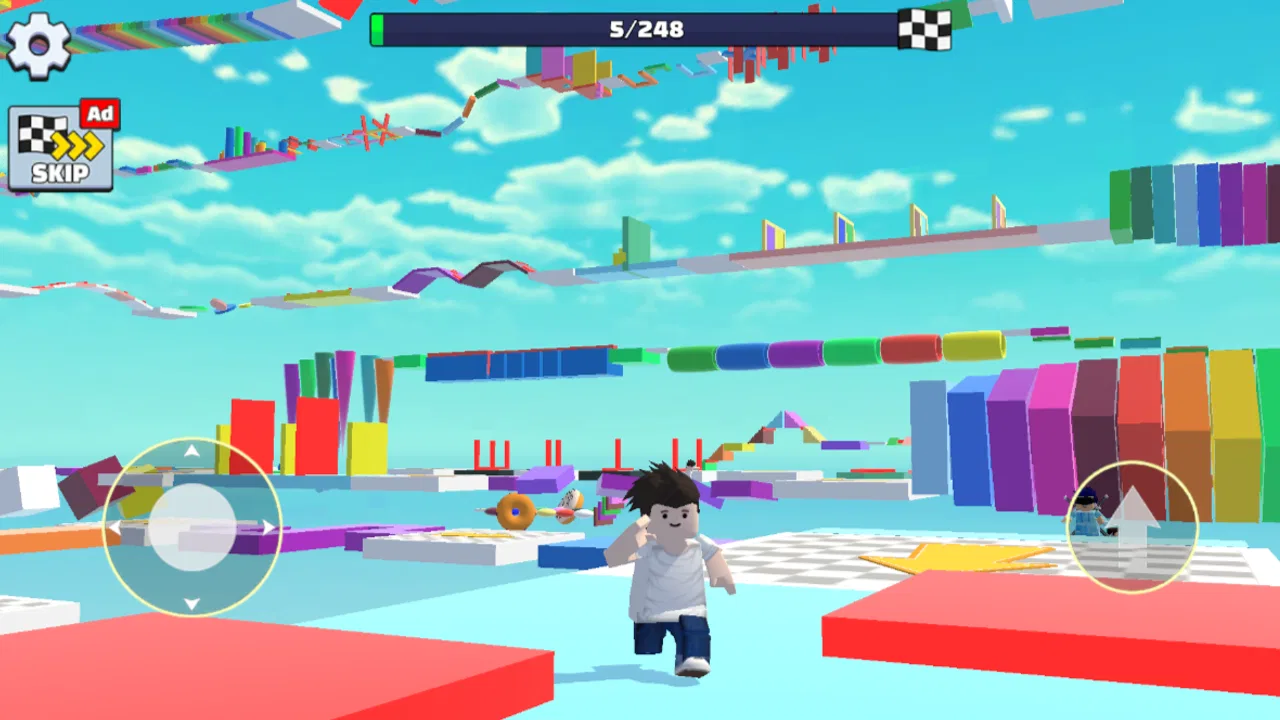
Easy Parkour: Escape Run Obby is a casual obstacle-course game focused on running, jumping, climbing, and avoiding hazards. Players guide their character through colorful escape-style levels filled with platforms, traps, gaps, and checkpoints. Although the title suggests an easy experience, some sections still require accurate timing and patience, especially when moving across narrow platforms or repeating difficult jumps.
02Is Easy Parkour: Escape Run Obby suitable for beginners and children?
The game is generally designed to be accessible to beginners because its controls are simple and the early stages introduce the basic movement mechanics gradually. It can also appeal to younger players who enjoy short obstacle challenges. However, difficulty may increase as the levels progress, and parents should review the game’s advertising, permissions, and any available in-app purchase options before allowing children to play.
03How does the gameplay and control system work?
Gameplay usually centers on moving forward through an obstacle course while controlling direction, jumping over gaps, and avoiding objects that reset progress. The controls are straightforward, making the game easy to pick up on a touchscreen. Nevertheless, responsiveness can depend on the device and the player’s timing. Taking a slower approach is often more effective than rushing through unfamiliar sections.
04Does Easy Parkour: Escape Run Obby require an internet connection?
Whether a constant internet connection is required can depend on the version and platform from which the game is downloaded. Basic gameplay may work offline in some releases, but advertisements, updates, analytics, leaderboards, or other online features might need connectivity. It is best to test the game after installation with Wi-Fi and mobile data disabled if offline play is important to you.
05Are there advertisements or in-app purchases in Easy Parkour: Escape Run Obby?
Many free mobile obstacle games use advertisements to support development, and Easy Parkour: Escape Run Obby may display ads between attempts, after completing stages, or when offering optional rewards. Availability of purchases can vary by version and region, so check the official store listing before downloading. If children use the app, parental controls and purchase restrictions are recommended to prevent accidental spending.
Pros
- Simple controls make the game easy to pick up on mobile.
- Short obstacle courses are suitable for quick play sessions.
- Bright visuals make platforms and hazards easy to recognize.
- Progressing through levels provides a clear sense of challenge.
- Parkour gameplay can improve timing and reflexes.
Cons
- Some stages may feel repetitive after extended play.
- Precision jumps can be frustrating on smaller screens.
- Difficulty may vary noticeably between different levels.
- Frequent retries can become tedious when checkpoints are limited.
- Performance may depend on your device and game version.

Easy Parkour: Escape Run Obby
Gallery